Author: fuzapost

  • The oldest profession?

    Apologies for the late sharing last week, the integration between WordPress and Linkedin/Facebook was more login-dependent than I realised! I hope you managed to catch up when it was shared on Tuesday instead.

    And-now

    Accounting

    As a novice small business owner, one of the first things I did was find an accountant, so I could make sure I was legally compliant and not doing anything silly in terms of the way I was doing my finances. I am not an accountant, so clearly the contents of this blog does not constitute advice, may be incorrect, relates to UK specifically, and is for general interest only :p.

    I visited a local accountancy practice, who did a free 1hr no-commitment consultation. This was useful in terms of answering my immediate questions, which were around how to extract money from the company and how to not-mess-up dealing with “The Taxman”. This materialised as questions like:

    • Should I pay myself a salary?
    • Should I register for VAT?
    • How should I do “expenses”?

    The answers to these were:

    • Salary yourself as little as you can afford, and as soon as you start paying yourself ensure it is at least the minimum wage. Once you start paying yourself, you will have to do this monthly and tell HMRC (Her Majesty’s Revenue and Customs) about it. HMRC  are the tax department of government in the UK.
    • VAT register as late as possible (since it requires yet more paperwork) unless you have big capital expenditure (which I don’t). You only have to VAT register after something like £83,000 turnover.
    • Expenses should make things look obviously like the legitimate business expenses they are, so it doesn’t matter too much whether it is paid on a company bank card or on personal bank card, as long as you keep it all logically separate. The problem is when you buy something using entirely company money and use it for non-company things.

    I decided, as part of my ever-continuing education, to complete my first set of accounts myself (with a little help).  As a result of this, I also learned:

    1. Accountants are charging a lot for what are simple activities once you know how to do them. For me, from scratch, it took about a day to put together my first set of accounts. My local accountant was charging over £500 for the same thing (which I guess would take them much less than half the time it took me).
    2. There are lots of tricks to legitimately avoid paying tax, which can be found on online forums or by paying accountants (if you are interested in reducing tax payment).
    3. Micro-entity accounts really do make things easy for very small companies, since they don’t ask for too much detail. [1]
    4. The “government gateway” website, which links nicely with Companies House, is actually pretty usable.
    5. Double-entry bookkeeping is almost a millennia old, the oldest complete set coming from the Republic of Genoa in 1340 [2]. Accounting itself may be from around 5000BC, pre-dating even money as Babylonians used it to keep track of livestock.
    6. It is definitely worth copying someone else’s spreadsheets (google or ask around) for cashbook, expenses and accounts templates.
    7. Little bit of lean: I’m now getting some sense of “flow” from my expenses. When I get home after a day out on business, I get all my receipts and (before I even have a cup of tea) I put them into my expenses spreadsheet, numbering and filing each receipt. Not only does this mean I get it “Done” and remove the activity of finding  and sorting receipts, but it means that I don’t dread spending hours once every few months doing expenses.

    I’m really glad to have done a set of accounts so I know how it works, and if I decide to pay an accountant to do it in future I will know what I’m paying for. Overall I’d say doing this once is a highly recommended experience, much like having a vaccination.

    tl;dr; Accounting is pedantic but not hard.


    [1] https://www.gov.uk/annual-accounts/microentities-small-and-dormant-companies

    [2] https://en.wikipedia.org/wiki/History_of_accounting
  • Should I buy wine?

    Orley Ashenfelter, an economist at Princeton, wanted to guess the prices that different vintages of Bordeaux wine would have. This prediction would be most useful at the time of picking, so that investors can buy the young wine and allow it to come of age. In his own words:

    The goal in this paper is to study how the price of mature wines may be predicted from data available when the grapes are picked, and then to explore the effect that this has on the initial and final prices of the wines.

    For those of you not so au-fait with wine, prices vary a lot. At auction in 1991, a dozen bottles from Lafite vineyard were bought for:

    • $649 for a 1964 vintage
    • $190 for a 1965 vintage
    • $1274 for a 1966 vintage

    Wines from the same location can vary by a factor of 10 between different years. Before Ashenfelter’s paper, people predicted wine quality by experts, who tasted the wine and then guessed how good it would be in future. Ashenfelter’s great achievement was to bring some simple science to this otherwise untapped field (no pun intended).

    He started by using the things that were “common knowledge”: in particular that weather affects quality and thus selling price. He checked this by looking at the historical data:

    In general, high quality vintages for Bordeaux wines correspond to the years in which August and September are dry, the growing season is warm, and the previous winter has been wet.

    Ashenfelter showed that 80% of price variation could be down to weather, and the remaining 20% down to age. With the given inputs, the model he built was:

    log(Price) = Constant + 0.238 x Age + 0.616 x Average growing season temperature (April-September) -0.00386 x August rainfall + 0.001173 x Prior rainfall (October-March)

    As it turned out, this simple model was better at guessing quality than the “wine expert”: a success for science against pure intuition. The smart part of his approach was getting insight in to the things people felt mattered (weather) and checking that wisdom. Here, he showed that yes it is quite appropriate to use weather and age to model wine prices.

    Through the age variable, it also gives an average 2-3% annual return on investment [1] (note this is pre-2008 so is unlikely to behave like this today[2]).

    Should I buy wine? Quite possibly, as long as I don’t drink it all.


    Source: http://www.wine-economics.org/workingpapers/AAWE_WP04.pdf

    [1] http://onlinelibrary.wiley.com/doi/10.1111/j.1468-0297.2008.02148.x/abstract

    [2] http://www.wineinvestmentfund.com/latest-figures/performance-glance.aspx

  • Keep it lean

    I spent last week with a friend, trying to help him spring clean his house. He’s been struggling with feeling overwhelmed with all the complexities of life, and wanted some external help.

    “Being lean” isn’t reading a book. “Being lean” is “being lean”. [1]

    Key principles to articulate:

    • Limit work in progress – e.g. do one thing at a time
    • Make it visual – e.g. through a physical board and colourful post-its
    • Keep inventory small – e.g. don’t waste time writing out the 50 things you wish were doing already, just write down the first 5 and crack on
    • Sustainability is important – both in terms of pace and what happens after you (the trainer) are gone

    You’ll notice the above are all “for example” rather than “this is exactly how you must do it.” As a coach, and as a mathematician,  I don’t care how you do it, I care that it is smart. And the above principles are either psychologically or mathematically sensible. This is also why the role of Scrum Master does not make sense, but Agile Coach perhaps does.

    Cue Kanban board!

    williamkanban
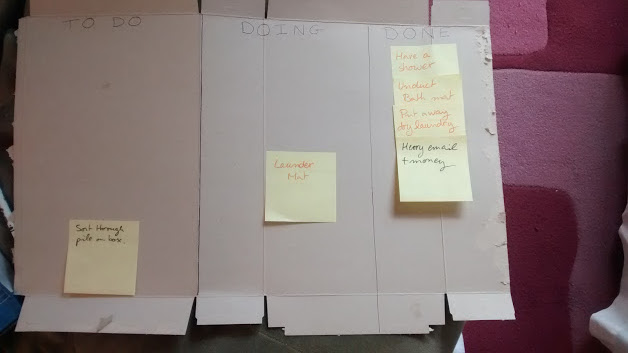
    Low budget Kanban board

    Especially with novices, this doesn’t need to take very long. As you can see, the above has been assembled (by the trainee) using a cereal box. It is very important the trainee does it themselves, so they feel ownership.

    Contrary to popular belief, smaller is better. Small tasks make it feel more sustainable, and help give more endorphins as you move to “Done” more frequently. Just like a production line, which is where Kanban was famously popularised. [2]

    Supporting others in their lean journey is about giving them tools, not doing things for them. If your friend wants their house clean, it might help in the short term to clean their house for them: but it will just get dirty again. The essence of this is something like “Give a man a fish and you feed him for a day, teach a man to fish and you feed him for a lifetime”, and it extends further to “Why are you eating fish?” and “Have you thought about farming?”

    It is much smarter to give them the ability and motivation to clean it themselves, and techniques and motivation to keep it up once it is in a reasonable state. Better still is to give them the broader desire and ability to reflect more fully, to understand why this matters to them and how it helps them on a deep level (psychologically, spiritually, philosophically, e.t.c.) Or maybe it doesn’t and they shouldn’t be prioritising doing it.

    Motivation is key. Without it, there would be nothing done. As a coach, your role is about inspiring more than anything else. If you can build a sustainable flame in someone, they can easily google the rest.


    [1] https://xkcd.com/703/

    [2] http://www.toyota-global.com/company/vision_philosophy/toyota_production_system/just-in-time.html

  • Data-Driven Decisions in Culture Change

    Today I want to share some thoughts around data-driven decisions. Rather than present some evangelical-sounding argument, I think it might help if I speak from my personal experience:

    • I care about data because it is the only way I know if I’m getting better.
    • It also helps me to think about what truly matters.

    Seriously, I apply this to everything: from my work, to my workouts, to my gardening, to my…

    Enough of that. Let’s take a real example: let’s say our goal is

    “Make the company culture better”

    The first obvious question is what does “better” mean? This is always worth a proper discussion. For our purposes now, let’s say we’ve agreed for our purposes it means that people enjoy being at work, and are productive.

    So how would we know if we were changing that? That’s when it gets difficult, and very important, to measure: since then we can see what things (experiments) we do that impact this.

    On the “people enjoying being at work” topic, we might look at some quantitative measures from People data such as “rate at which people leave the company” or “hiring ability”, together with some softer, qualitative, conversation-based data. We might even want to construct things, like a culture survey or exit interviews, to understand some specific aspects of what matters to us.

    Then in terms of “productivity” (or some measure of value delivered), we might want to look at the customer benefit delivered each week, in £. This might be too hard (indeed I’m not sure anyone has cracked it [1]), so we’re looking at throughput (a count of stories done in a time interval) instead as a proxy-measure. If you have any ideas of how we could do that better I’d be really keen to hear them!

    Following scientific method:

    1. First, we want a baseline: to capture what the current status of these things is.
    2. Then, we want to conduct smart, hypothesis-driven experiments, so we can see if these genuinely do impact things: being sure to take repeatable measures.

    Unfortunately for our example, this interactive human behaviour is almost the definition of a Complex Adaptive System [2], so it won’t be easy to show causation – we’d need to do some Principle Component Analysis [3] (or similar) and that would require “long” and ideally also “wide” data, together with experiments and consciously-held-out subsets. In a business environment, this is hardly pragmatic.

    We can though at least show that something important has changed, even if we can’t easily prove why it changed.

    By gathering data that matters, you too can be data-driven! Experiment with this on something simple to start with, and see whether it works for you. It might be what time of day to commute to work, your own wellbeing, or the quality of your code. Let us know in the comments below what you try and how it goes!

    [1] http://agileresearchnetwork.org/wp-content/uploads/2015/07/Measuring_value_in_agile_projects_WP.pdf

    [2] https://en.wikipedia.org/wiki/Complex_adaptive_system

    [3] https://en.wikipedia.org/wiki/Principal_component_analysis

  • My first… business proposal

    Several months ago I had my first ever formal pitch to a company where I didn’t know the people at beforehand, and I found my notes on it which I thought I’d share! It was actually not that intimidating, as they were really nice and I’ve had more practice now.
    The bit that kinda stressed me out was writing a formal Business Proposal, which they asked for afterwards. Whilst I have been on the receiving end of these sorts of things, I’d never written one. To make matters slightly more pressured, they wanted it within a week.

    IMG_20160305_150357
    I didn’t actually use this

    Things that helped:

    • I secured an “in” to be able to talk more to their techie, who was awesome and really helped me get to grips better with their problem
    • I gave several thought-through options, given that it would be a new relationship I wanted to make sure I explained my preferences to them, and gave them a better understanding of my expertise
    • I asked for feedback several days before the deadline from their Project Manager, to make sure I was providing what they wanted
    • I used LaTeX to write it, which meant I didn’t need to muck around too much with making a custom stylesheet, since it looks great without effort

    Things that were hard:

    • I had no idea really of timescales (#noestimates), and from initial conversations this was very important to the client. I made sure to give an option to be more lean about it: by which I mean take the most important small chunk and do that as fast as possible
    • Deciding on pricing, for a customer used to having free work done for them :/

    If you’re doing a Business Proposal, don’t panic, it’ll be fine: just get as much feedback as you can so that you have an engaged, happy customer.

  • More Happiness!

    One of the things I’m trying to optimise for is my happiness. Hopefully it doesn’t come as a huge surprise that this is a pretty complex thing to do. In my time as an Agile Coach, I’ve read a lot of literature of varying quality on this, and indeed hopefully have helped others to use this to find increased happiness for themselves.

    From the studies supporting “Thinking fast and slow” it is clear that present happiness and “remembering happiness” are two very different things, both of which would need to be considered. [1]

    IMG_20150925_084513.jpg
    A happy (in the present) panda

    Through my reading of several studies, there is one key thing that I want to call out in this post: social connectedness. It turns out that social connectedness is a better predictor of happiness than any other variable (such as money or education).[2]

    As someone going from full-time employment (with a built-in 5-day-a-week social) to self-employment, I was worried that I’d lose a lot of the social connection I had in my life.

    To combat this, I agreed to spend 2 days a week in an office coaching teams. I also joined a few local clubs, and committed to myself that I’d go to some interesting meetups.

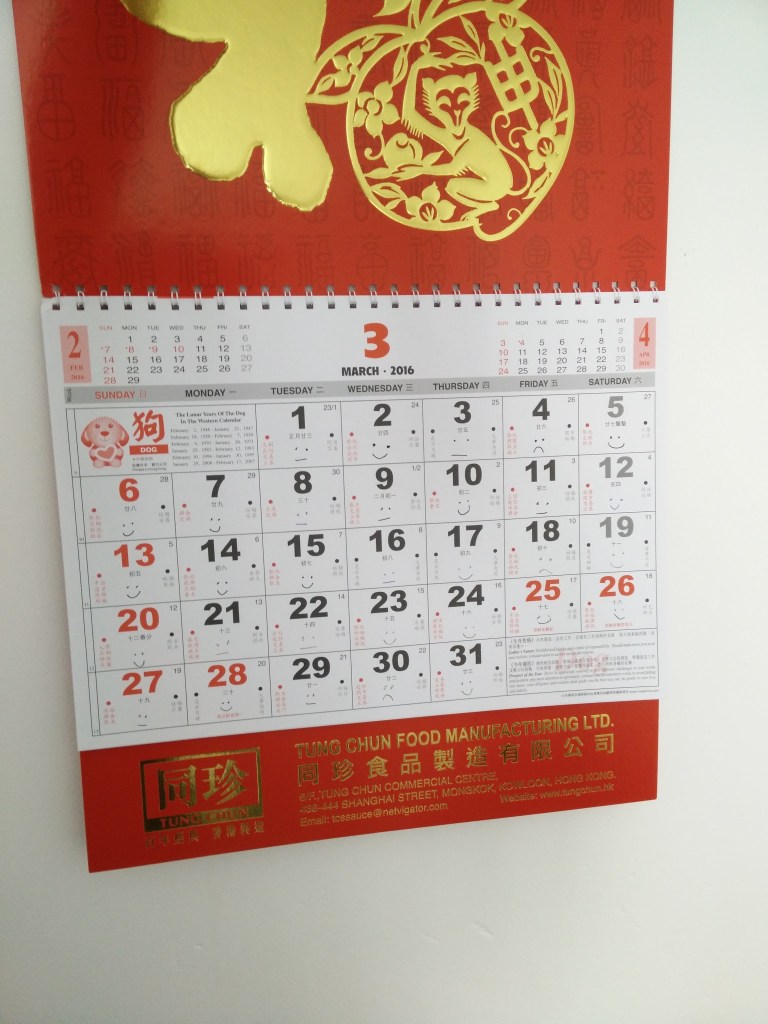
    I’ve also been measuring my happiness day by day, and reflecting on it, in order to cover both “types” of happiness. I draw smileys on my calendar each morning, and do a monthly check on how I feel the last month was.

    2016-05-15
    With thanks to Tung Chun Food Manufacturing Ltd.

    I know this isn’t very advanced, or even scientific. By using this basic data, I’m trying to understand just a bit more about how I feel, and see whether changes I make (such as joining a club, or doing more running) make a measurable difference to my happiness. Also, through the mere fact that the data exists, I ensure I focus on it more, which is what I want anyway! [3]


    [1] Kahneman’s TED talk https://www.youtube.com/watch?v=XgRlrBl-7Yg

    [2] http://www.hks.harvard.edu/saguaro/communitysurvey/results4.html

    [3] https://en.wikipedia.org/wiki/Hawthorne_effect

  • The journey to a company culture

    I like to think of culture as what happens when no-one is looking.

    As a new company, you’re in a unique position to genuinely define your culture, rather than adapt to someone else’s [1]. Who do you want to be? What matters to you beyond your Product or service?

    IMG_20160306_173110.jpg
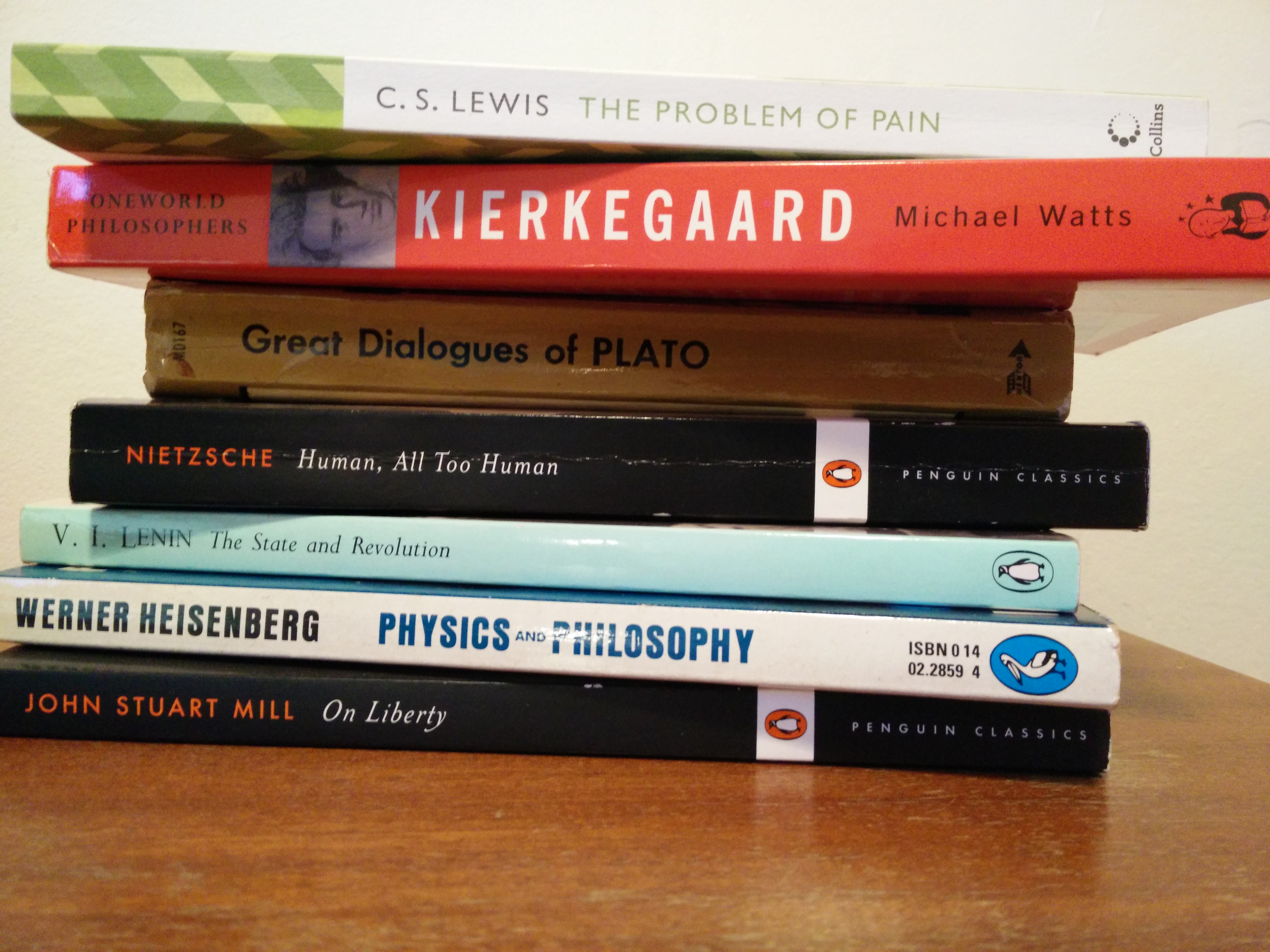
    Some books

    I’ve found a number of challenges to the cultural philosophy I want to live, the strongest of which (for me at least) are from customers. To be specific, I found many customers wanted a fixed price arrangement. This would mean:

    • defining work up front
    • attempting to estimate duration
    • committing myself to a potentially large chunk of time

    As I discussed with them, I don’t want to do any of those things, in the interest of the customer getting great value[2]. I want us to be able to pivot as we learned more, so we can work on what matters rather than what happened to be in the contract. This is the spirit of the value of genuine “Collaboration” that Fuza has[3], which I believe means I need to share the same goals as my customer. Luckily most of the people who are interested in working with Fuza are keen to make smart decisions, and have understood and embraced the attitude.

    The key reason: Without shared vision for the work, we cannot work to get the same benefit and it can become a purely capitalist transaction. When I work, I want to feel and genuinely be a set of people working together for the same thing, as this sense of shared purpose is motivating [4] and as such I am confident it will lead to not just better delivery but also more engaged and happier customers. I’m sure this holds for people working in larger and longer-established companies too: we all like to have purpose. Hopefully one day soon we can get some solid scientific studies to help us understand how to share that purpose effectively.

    [1] https://en.wikipedia.org/wiki/Social_philosophy

    [2] http://www.agilemanifesto.org/

    [3] See www.fuza.co.uk for more info on our values.

    [4] Incase you haven’t watched it, http://www.ted.com/talks/dan_pink_on_motivation?language=en

  • The key to being awesome: feedback

    Last week I was talking with one of my friends. “I’m going to get fired, I know for sure I am delivering below what they had hoped” he said.

    This isn’t the first time I’ve heard these kinds of fears voiced. I encouraged him, as I am now encouraging you, to SEEK FEEDBACK. There is no need to live with insecurity. Everyone should do this, as it is valuable information about ourselves that we can use to self-improve. Doing this regularly is even better! There is no need to wait a year for your annual appraisal: by getting quicker, regular feedback we learn faster. With this in mind, please do take a minute to give me feedback on this blog, either in the public comments, or privately here:

    Go back

    Your message has been sent

    Warning

    Warning.

    How can I get feedback?

    Often, feedback comes in an annual appraisal with your boss. You will likely also be getting some kind of feedback from your close friends (e.g. “it is really annoying when you turn up late Harry.”) In this post I’ll outline some well-established methods for getting professional feedback.

    Pick some people whom you value the opinion of. This probably will be people from work, but may include some friends or family. A broad variety of perspectives and relationships will help you get a fuller picture.

    Now there are many different ways I’ve seen for gathering this kind of feedback.

    Start, Stop, Continue

    This is arguably the simplest for a beginner: simply email some people asking them:

    • What should I start doing?
    • What should I stop doing?
    • What should I continue doing?

    They’ll reply with some things, and maybe you’ll want to follow up with a one-on-one discussion to check your understanding on some of the points.

    360 feedback

    You can do this as “Start, Stop, Continue” or as a custom SurveyMonkey form with some traits you’d like particular feedback on. The “360” element of this is that you should ensure you ask not just your manager, but also your direct reports and other peers. The top link on google when I looked was this example. It is very quantitative and trackable if you do it regularly. I would only recommend this particular site if you have a direction you want to develop in though, as it restricts ability to comment on some things, like say whether they’d really appreciate it if you used some more effective deodorant.

    Johari Window

    This is a personality mapping test, where you can see how different people see you compared to your self-perception. I found this quite interesting and surprising. This is much more of a long-term improvement and measurement exercise, and again you won’t get specific feedback on performance, etc. in this. Try it out here.

    A conversation

    This is my favourite. It is best to give the other person time to prepare and get their thoughts in order about the feedback they’d like to give you. Keep it safe by using a start-stop-continue method or other framework if you prefer. If you have particular questions, you can ask them: again preparing this beforehand is great, but don’t hide behind a piece of paper. Ideally you’d both give one another feedback, since this is a great trust-building mechanism and you can both benefit!

    Other methods

    There are many other ways to get feedback. Let me know if you have another favourite in the comments below.

    How should I take it?

    Receiving feedback can be hard, especially if it feels critical. Remember this is an opportunity for you to grow, and these people are being nice enough to help you. If you take this with a developmentally-focused, rather than self-critical, mindset, then you’re on to a winner.


  • Collecting data, the smart way

    Here is my short, simple step-by-step guide for smart collection of data.
    Step 1) Determine what matters, ideally in accordance with a Company or Product vision
    Step 2) Come up with as many different ways of measuring aspects that matter or impact what matters
    Step 3) Collect data! Ideally setting up easily repeatable ways of this, and automated wherever possible
    Step 4) Form hypotheses: how do you believe certain measures affect your vision? What do you expect the data to tell you?
    Step 5) Collect more data
    Step 6) Test your hypotheses
    Step 7) Collect even more data. Quite simply, the more data the better.
    IMG_20160123_124341.jpg
    Bletchley Park: the more data the better
    Let’s look at an example. Suppose a government manager wishes to improve the innovation of her employees.
    Step 1) Target: what matters here is “innovation” – which we define more precisely in…
    Step 2) Measurement: Some of the ways in which innovation can be measured are volume of ideas, number of staff submitting ideas, percentage of staff submitting ideas, value delivered, employee perception of innovation produced, manager perception, and customer perception (in this case the public would be the customer), etc.
    Step 3) Collection: This involves ensuring that things are centrally recorded and surveys are done to create a baseline.
    Step 4) Hypothesis: It is suggested that an innovation rewards’ ceremony would help to improve the morale. Note that it is important that the hypothesis is formed after the first data collection, as we want to be able to dig deeper into anything interesting we find. This means that often we need to collect more detailed data more specifically targeted towards proving or disproving our hypothesis.
    Step 5) Collection: A more accurate, probably quantative, measure of morale is added to the existing survey.
    Step 6) Action: An innovation rewards’ ceremony is run.
    Step 7) Collection: The survey is conducted again – morale is measured as having improved. Success! Note that the other measures (e.g. the volume of ideas produced) are now also being consistently measured and can be easily tracked throughout future experiments.
    After running through these steps we can ask ourselves the following questions.
    What do we now know?
    • Key measures, and how they are changing with time
    • Whether the key measures remain the same, or if other aspects should be considered.
    What can we not imply?
    •  “Correlation does not imply causation”: just because a trend becomes apparent this does not mean that one workplace modification is the main contributor to a measured difference. For example, if morale improves during the summer months this may have been due to nicer, warmer weather rather than any particular managerial decisions.
    • We cannot assume that any trends apply in similar cases elsewhere: our sample is too small and too specific. Luckily, a full research paper is not the goal here!
    As some of you may have noticed, this is very similar to the Six Sigma methodology of “Define, Measure, Analyse, Improve, Control”. It also mirrors the “Plan, Do, Check, Act” process found in many management handbooks.
    The detail of the steps you yourself follow is not particularly important here, all I am really suggesting is to:
    • Ensure you are working on what really matters.
    • Add wider data collection before directing all your attention to one particular area. This way you will have a richer understanding of the problems and opportunities.
  • Making lean decisions in the wild

    IMG_20160403_151839
    The wild

    In the lead-up to founding a company, like many others in my position, I thoroughly enjoyed “The Lean Startup” by Eric Ries. Inspired accordingly, I’ve been trying to make smart decisions, in particular by making decisions at the right time. This post is really about the idea of deciding as late as possible, in order to reduce waste and increase pivot-ability.

    There are SO MANY things to think about – from the impact on the rest of life, to coding some software, to actually running the business – that it’s really important to be able to correctly prioritise or risk being overwhelmed.

    Let’s take some examples for decisions it is tempting to take on day zero of starting a new company:

    • Company name: needed for URL and company registry, so pretty important to do early
    • Company logo: not needed for URL or company registry, so don’t even think about it yet

    One thing that took me a large amount of time and effort to make a decision on was on computing hardware, mainly because it directly involved money. It wasn’t entirely clear at what point I needed to make the decision. I didn’t even know what I’d need, and it is quite difficult to be adaptable when buying hardware (for example upgrading from one graphics card to another could be a waste of cash.)  

    I had a few clear criteria though:

    • “Presentable” and transportable for working on client sites, right now
    • Able to build mathematical models whilst working in the home-office
    • Be a good value purchase

    Considering my requirements, it seemed like there were two logically separable requirements that probably justified two different pieces of hardware, particularly if it meant I could delay one decision.

    Firstly, I ended up choosing an Asus Chromebook Flip for its easy google integration for client work, because the tablet format would be useful during presentations, plus I needed something for this right away.

    IMG_20160403_152702
    Working on the kitchen table

    For the second criteria, I decided to use my (pretty old) PC as a modelling computer in the meantime so I could learn more about what I need. At the point when I have to upgrade, I will. In this sense, the lean philosophy of making the decision as late as possible has felt really helpful.